Software development
Agile software development: a practical guide
What agile really means, how sprints, Scrum and Kanban work, where testing and CI/CD fit, and what agile asks of you as the client.
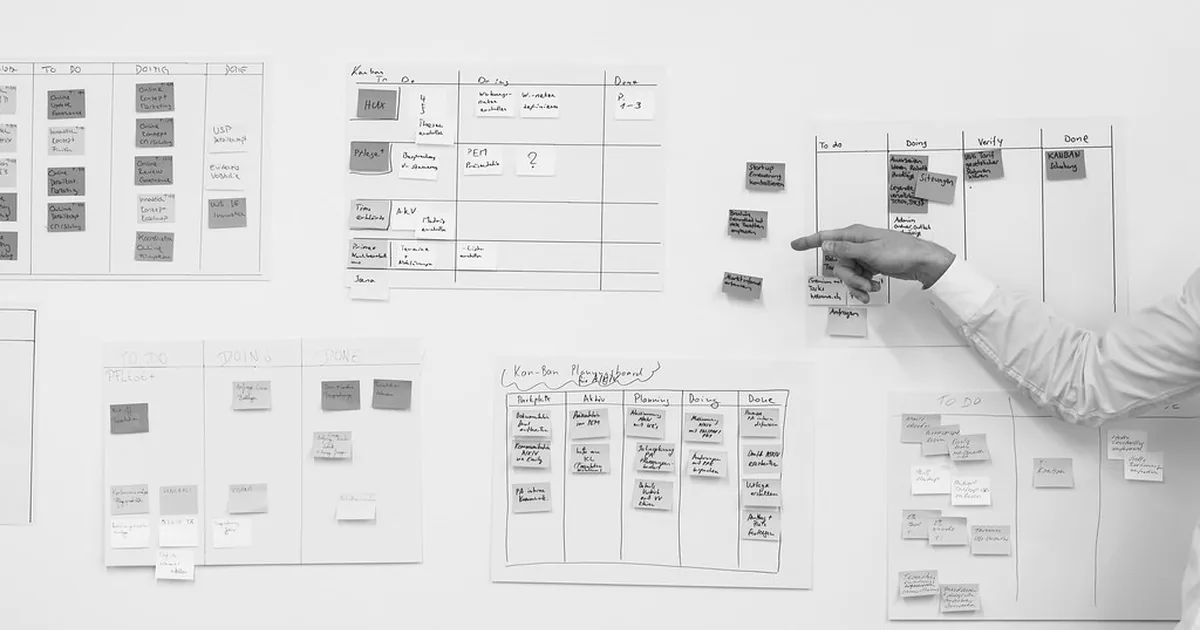
Most software projects don't fail because of bad code. They fail because the team built the wrong thing, found out too late, and had no cheap way to change course. Agile software development exists to fix that. Instead of one long plan and one big launch, you build in short cycles, show working software often, and let real customer feedback steer what comes next.
This guide is for founders, product leaders and anyone commissioning software. It covers how the agile methodology works in practice, and what it demands from you as the client, a part most guides skip. If you're planning a build, our custom software development page shows how we apply these ideas in practice.
Key Takeaways
- Agile software development delivers software in short, repeatable cycles, so you see working features every few weeks instead of waiting months for one big release.
- In the Standish Group's CHAOS 2015 data, agile projects succeeded 39% of the time versus 11% for waterfall, roughly three and a half times as often.
- Scrum is the most used team-level method (87% of respondents in Digital.ai's 2022 survey), followed by Kanban (56%).
- The biggest barriers are not technical. Among dissatisfied respondents, a clash with company culture was the leading cause of failed delivery (41%), and the 2025 report found that only 15% of business leaders take part meaningfully in agile practices.
- Agile only works when the client stays involved: someone with authority must own the product backlog and attend sprint reviews.
In this guide
- What is agile software development?
- The Manifesto and 12 agile principles
- Agile vs waterfall
- Agile frameworks: Scrum, Kanban and beyond
- How an agile sprint works, step by step
- Continuous integration, continuous delivery and testing
- Cross-functional teams: who does what
- Start small: the minimum viable product
- Benefits and challenges of agile project management
- How to choose an agile software development partner
- Frequently asked questions
- Making agile work for your project
What is agile software development?
Agile software development is an approach to building software in small, working increments, with frequent feedback from users and stakeholders deciding what gets built next. Requirements are expected to change, and the process is designed to absorb that change cheaply rather than resist it.
In a traditional software development process, a team gathers all requirements up front, designs everything, builds everything, and tests at the end. Agile breaks that sequence into short loops. Each loop produces something usable, and each loop is a chance to correct course.
Iterative development vs incremental development
Two ideas sit at the core of agile, and they are often confused:
- Incremental development means delivering the product in pieces. Login first, then search, then payments. Each piece adds to what already works.
- Iterative development means revisiting and refining what you've built. The first version of search is basic; the next iteration improves it based on how people actually use it.
Agile teams do both at once. They ship small increments and iterate on them. The result is a product that grows in usable steps and gets better with each pass.
Where agile came from: the Manifesto and 12 agile principles
In 2001, seventeen software practitioners met in Utah and wrote the Manifesto for Agile Software Development. It is four lines long. It says the authors value:
- Individuals and interactions over processes and tools
- Working software over comprehensive documentation
- Customer collaboration over contract negotiation
- Responding to change over following a plan
The Manifesto adds that "while there is value in the items on the right, we value the items on the left more." Agile is not anti-documentation or anti-planning. It is a statement of priorities.
Behind the four values sit 12 agile principles. The ones that matter most to a business buying software are:
- Early and continuous delivery of valuable software is the highest priority.
- Changing requirements are welcome, even late in development.
- Deliver working software frequently, from every couple of weeks to every couple of months, "with a preference to the shorter timescale."
- Working software is the primary measure of progress. Not reports, not percentages, not slide decks.
- Teams reflect at regular intervals on how to become more effective, then adjust.
Agile vs waterfall: how the software development process changes
The clearest way to understand agile is to compare it with waterfall, the sequential model agile was a response to.
| Dimension | Waterfall | Agile |
|---|---|---|
| Planning | Full scope fixed up front | High-level goal; detail planned each cycle |
| Delivery | One release at the end | Working software every few weeks |
| Change | Expensive; needs a change request | Expected; handled through the backlog |
| Customer feedback | Mostly after launch | Every sprint review |
| Software testing | A phase near the end | Continuous, built into every cycle |
| Risk | Discovered late | Surfaced early, in small pieces |
The outcomes differ too. The Standish Group's CHAOS 2015 report found that agile projects succeeded, by Standish's own definition, 39% of the time, compared with 11% for waterfall projects (Info-Tech SoftwareReviews, reproducing the Standish Group CHAOS 2015 data). That makes agile projects roughly three and a half times as likely to succeed. The mechanism is simple: small, frequent releases expose problems while they are still cheap to fix.
The data is from 2015, so treat it as directional rather than a forecast for your project.
Waterfall still has a place. If requirements are fixed by regulation and genuinely won't change, a sequential plan can work. For most products, where you learn what users want by watching them use the software, agile is the safer bet.
Agile frameworks: Scrum, Kanban and beyond
"Agile" is a set of values. Agile frameworks are the concrete ways teams put those values into practice. Digital.ai's 16th State of Agile Report, a 2022 survey of 3,220 respondents, found Scrum in use by 87% of respondents, Kanban by 56% and Scrumban by 27%, with many teams using more than one. For coordinating many teams, the most used scaling framework was SAFe at 53% (IT Brief, reporting on the Digital.ai survey, December 2022).
Scrum
Scrum organises work into sprints: fixed-length cycles of one month or less, according to the official Scrum Guide. Two-week sprints are a common choice for product teams. The Scrum Guide defines three accountabilities:
- Product Owner: decides what gets built and in what order, and owns the product backlog.
- Scrum Master: helps the team use Scrum well, removes blockers and protects the team's focus.
- Developers: the people who build the increment, including engineers, designers and testers.
Scrum also defines five events (the sprint itself, sprint planning, the daily scrum, the sprint review and the sprint retrospective) and three artifacts: the product backlog, the sprint backlog and the increment.
Kanban
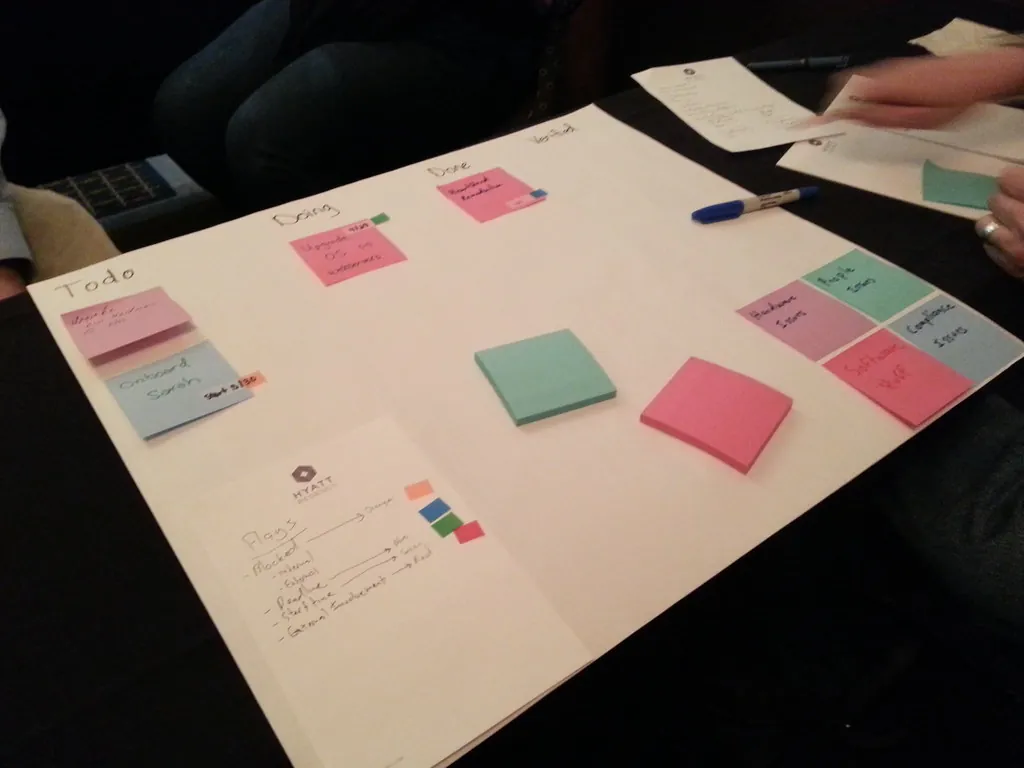
Kanban doesn't use sprints. The Kanban Guide describes it as "a strategy for optimizing the flow of value through a process." Work moves across a Kanban board with columns such as To do, In progress, Review and Done. The key rule is a work-in-progress (WIP) limit: a column can only hold so many items, which forces the team to finish work before starting more.
Kanban suits continuous streams of work, such as maintenance, support and operations, where priorities change daily and fixed sprints feel artificial.
Scaled and hybrid approaches
Larger organisations often add a scaling framework such as SAFe (Scaled Agile Framework) or Scrum@Scale to coordinate many teams. In the 2022 survey, SAFe was the most used scaling framework (53%), and Scrum@Scale or Scrum of Scrums reached 28%. Pure frameworks are now the minority. In Digital.ai's 18th State of Agile Report (2025), 74% of respondents said they use hybrid or homegrown models (Scrum.org summary, November 2025). Many teams run Scrum for product work and Kanban for support, and that's fine. The framework should serve the team, not the other way round.
How an agile sprint works, step by step
Here is what a typical two-week Scrum sprint looks like from the inside. The timeboxes come from the Scrum Guide and are maximums for a one-month sprint; shorter sprints use shorter meetings.
| Event | Purpose | Maximum timebox (one-month sprint) |
|---|---|---|
| Sprint planning | Agree the sprint goal and the work to reach it | 8 hours |
| Daily scrum | Check progress toward the goal; adjust the plan | 15 minutes |
| Sprint review | Show the increment to stakeholders; gather feedback | 4 hours |
| Sprint retrospective | Improve how the team works | 3 hours |
1. The product backlog and user stories
Everything starts with the product backlog: an ordered list of everything the product might need. The Product Owner keeps it sorted by value, so the most important items are always at the top.
Backlog items are usually written as user stories, short descriptions of a need from the user's point of view:
As a fleet manager, I want to see every vessel's last reported position on one map, so that I can spot delays without calling each captain.
A good user story has clear acceptance criteria, the conditions that must be true for the story to count as done. For the example above: the map loads in under three seconds, shows positions no older than 15 minutes, and flags vessels that haven't reported in an hour. Without acceptance criteria, "done" becomes a matter of opinion.
2. Sprint planning
At sprint planning, the team picks the top backlog items it can realistically finish in the sprint and agrees on a single sprint goal, such as "Fleet managers can see live vessel positions." The selected items, plus the plan to deliver them, become the sprint backlog.
How much fits? Most teams size backlog items relative to each other, often with story points, and use their recent velocity (how much they actually finished in past sprints) as a planning aid. Velocity helps a team forecast its own capacity; it is not a performance score to compare teams.
The sprint goal matters more than the list. If a story turns out bigger than expected, the team can trim scope while still meeting the goal.
3. Daily work and the daily scrum
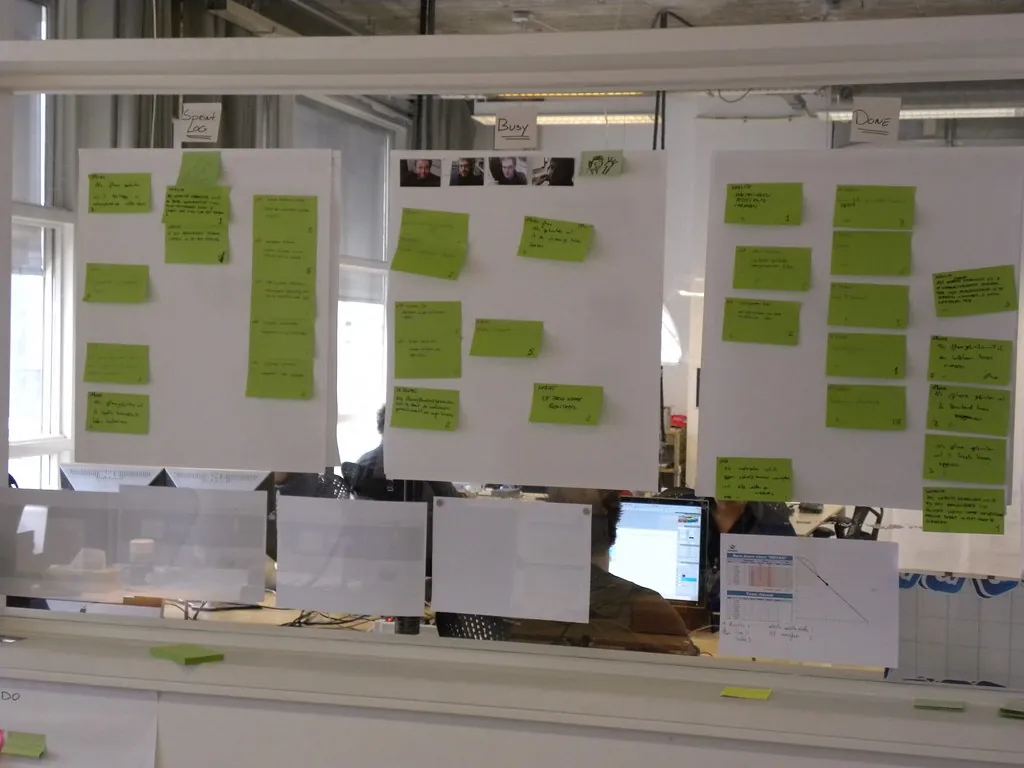
Each day, the developers meet for a 15-minute daily scrum to check progress toward the sprint goal and flag blockers. It inspects progress toward the sprint goal and adjusts the upcoming work; it is not a status report for managers.
Each story is finished only when it meets the Definition of Done, the team's shared quality bar.
4. Sprint review and customer feedback
At the end of the sprint, the team demonstrates working software at the sprint review. This is where customer feedback enters the process. Stakeholders use the new features, react, and the Product Owner reorders the backlog based on what they learn.
For a client, the sprint review is the single most valuable meeting in agile. It's where you see real progress, not a progress report. We run fortnightly demos at Dignisys for exactly this reason: decisions, scope and progress should be visible, and nothing makes them more visible than working software. You can read more on how we work.
5. Sprint retrospective
Finally, the team holds a retrospective to discuss what went well, what didn't, and one or two concrete changes for the next sprint. Then the cycle starts again.
Continuous integration, continuous delivery and software testing
Short sprints only work if the code is always in a releasable state. That is the job of continuous integration and continuous delivery, often shortened to CI/CD.
- Continuous integration (CI): every developer merges their changes into the shared codebase at least daily, and an automated build with tests verifies each merge. Martin Fowler's widely cited guide to continuous integration describes the core practices: a single mainline, a self-testing build, a build on every push, and fixing broken builds immediately.
- Continuous delivery (CD): every change that passes the pipeline can be released to production at any time, usually with one click or automatically.
Google's DORA research programme measures how well teams deliver software. Its 2024 report grouped teams into performance clusters; the top and bottom look like this (DORA 2024 Accelerate State of DevOps Report; cluster table as reproduced by Octopus Deploy):
| Metric | Elite performers | Low performers |
|---|---|---|
| Deployment frequency | On demand | Once a month to once every six months |
| Change lead time | Under one day | One to six months |
| Change failure rate | Around 5% | Around 40% |
| Recovery from a failed deployment | Under one hour | One week to one month |
DORA's broader finding is that speed and stability are not trade-offs: the best teams do well on both (DORA metrics guide).
Where software testing fits
In agile, software testing is not a phase at the end. It happens inside every sprint:
- Unit tests written alongside the code check individual functions.
- Integration and API tests check that components work together.
- Automated end-to-end tests cover the critical user journeys, such as sign-up and checkout.
- Exploratory testing by a human finds the problems scripts miss.
All of this runs in the CI pipeline on every change, so a regression is caught in minutes, not discovered by a customer weeks later.
AI coding tools make this discipline more important, not less. Google's 2025 DORA report found that 90% of survey respondents use AI at work, and that while AI adoption now improves delivery throughput, it is still associated with lower delivery stability (Google Cloud, September 2025). Small batches, automated tests and a strict Definition of Done are the guardrails that let teams use AI to go faster without breaking things.
Cross-functional teams: who does what
Agile depends on cross-functional teams: small groups that have every skill needed to turn a backlog item into working software, without waiting on other departments.
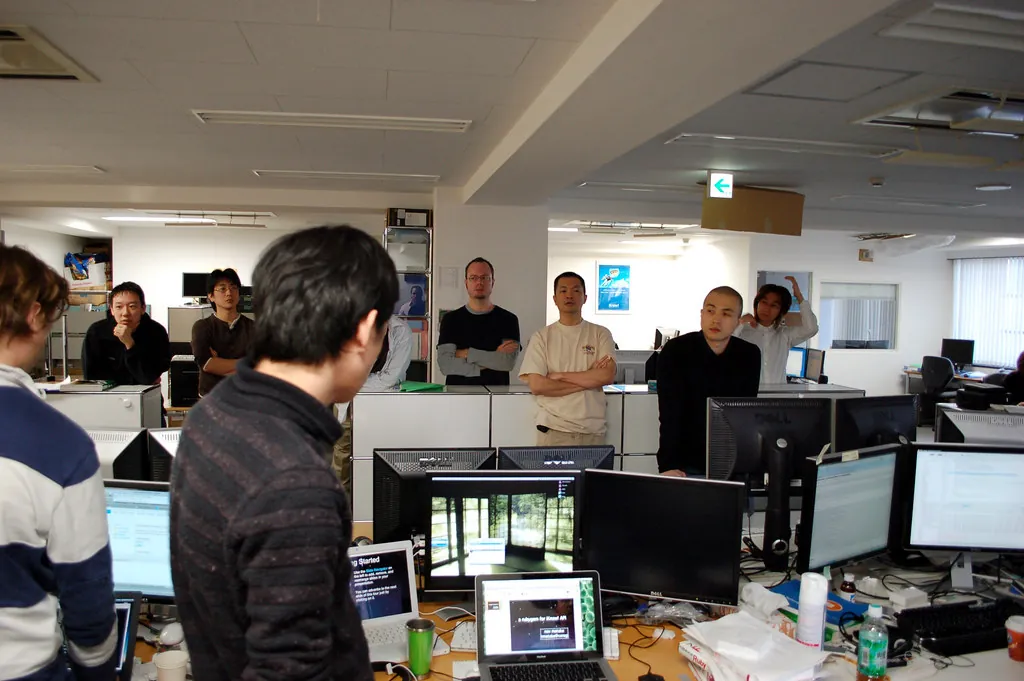
A typical product team might include:
| Role | What they own |
|---|---|
| Product Owner | The backlog, priorities and the final call on what ships |
| Scrum Master or delivery lead | The process, the cadence and removing blockers |
| Developers (frontend, backend, mobile) | Building and integrating features |
| UI/UX designer | User flows, interface design and usability |
| QA engineer | Test strategy, automation and quality gates |
| DevOps engineer | The CI/CD pipeline, infrastructure and monitoring |
On small teams, one person may cover several roles. What matters is that the skills sit inside the team, which is why we keep UI/UX design in the same delivery team as engineering.
Start small: the minimum viable product (MVP)
Agile and the minimum viable product (MVP) go together. An MVP is the smallest version of your product that solves a real problem for real users and lets you learn whether you're on the right track.
A common mistake is treating the MVP as version 1.0 with fewer features. It should be a deliberate boundary instead: one core user, one core job, done well. Agile makes that practical. You release the MVP after a handful of sprints, gather customer feedback, and let the product backlog reorder itself around what users actually do.
We've written a full guide on this: your MVP needs a boundary, not another feature. If you're starting from zero, a short discovery phase to define that boundary before the first sprint saves weeks later.
Benefits and challenges of agile project management
What teams gain
Agile project management changes how work is planned, tracked and reported. In Digital.ai's 17th State of Agile Report, 60% of respondents cited improved collaboration and 57% cited better alignment with business needs as benefits (SD Times, January 2024). Medium and large businesses were less positive: 43% said agile works very or somewhat well, nine points fewer than small businesses.
In plain terms, you get earlier value and lower risk: every sprint is a checkpoint, so a wrong turn costs two weeks, not six months.
Why agile fails
The same surveys show where agile goes wrong, and the leading causes are organisational, not technical. In the 2022 survey, among the 40% of respondents dissatisfied with agile at their organisation, a clash with company culture was the leading cause of unsuccessful delivery (41%). The report also pointed to management as a key barrier (IT Brief, reporting on the Digital.ai survey, December 2022).
The 2025 edition reinforces the pattern: only 13% of respondents said agile is fully embedded across their organisation, and that only 15% of business leaders participate meaningfully in agile practices (Scrum.org, November 2025).
The fixes are practical:
- Name a real Product Owner. Someone with authority to make decisions must be available every week, not just at kick-off.
- Attend sprint reviews. If stakeholders skip the demo, the feedback loop that makes agile work never closes.
- Protect the sprint. Changing priorities mid-sprint is a sign the backlog isn't being managed.
- Measure outcomes, not activity. Velocity charts say how busy a team is. Releases, adoption and DORA's delivery metrics say whether the work is paying off.
How to choose an agile software development partner
Many vendors say they're agile. Here's how to check, based on what actually separates a working agile process from a relabelled waterfall one:
- Ask to see a sprint review. A real agile team demos working software every sprint. If all you get is slides, that's a warning sign.
- Ask who owns the backlog and where it lives. You should have direct access to the product backlog and the project board, not a weekly summary of it.
- Ask about their Definition of Done. It should include code review, automated tests and deployment to a staging environment, at minimum.
- Ask how change is handled commercially. In a healthy setup, swapping a backlog item for another of similar size doesn't require a new contract. Phased or capped budgets often fit agile better than one large fixed-scope quote.
- Ask what happens after launch. Most software problems show up after launch, not before it. A partner should plan monitoring, maintenance and handover from day one. See our approach to software maintenance.
- Ask who owns the code. You should own the code and IP once invoices are paid, with full repository access throughout.
Frequently asked questions
Is agile the same as Scrum?
No. Agile is a set of values and principles described in the Agile Manifesto. Scrum is one framework for applying them, with defined accountabilities, events and artifacts. Kanban, Extreme Programming and SAFe are other agile frameworks.
How long is a sprint in agile software development?
The Scrum Guide sets a maximum of one month per sprint. Two-week sprints are a common choice because they balance planning effort with frequent feedback. Kanban teams don't use sprints at all; work flows continuously.
Can agile work with a fixed budget?
Yes. A fixed budget and a fixed timeline work well with agile; it's fixed scope that causes friction. With a fixed budget, the team delivers the highest-value backlog items first, so if money runs out, you still have the most important features working.
What does the client do in an agile project?
The client, or someone they appoint, usually acts as Product Owner or works closely with one. That means prioritising the backlog, answering questions quickly, attending sprint reviews and giving honest feedback on each increment.
Making agile work for your project
Agile software development replaces one big bet with many small, informed ones. You build in short sprints, show working software often, test continuously, and let customer feedback reorder the plan. The framework matters less than the habits: a well-ordered product backlog, a releasable increment every sprint, and a client who shows up to the sprint review.
If you're planning a new product or rescuing a stalled one, start with the piece you need now. Read more in our insights, or tell us what you're building. Discuss your project with Dignisys. We reply within one business day with next steps, questions or a time to talk.
About the authors. This guide was written by the Dignisys engineering team, a product engineering studio with teams in Mumbai and Chandigarh that designs, builds and maintains apps, custom software and SaaS products in two-week delivery cycles. Facts and figures were checked against the cited sources on 28 November 2026, in line with our editorial policy.